XKCD on Climate Change
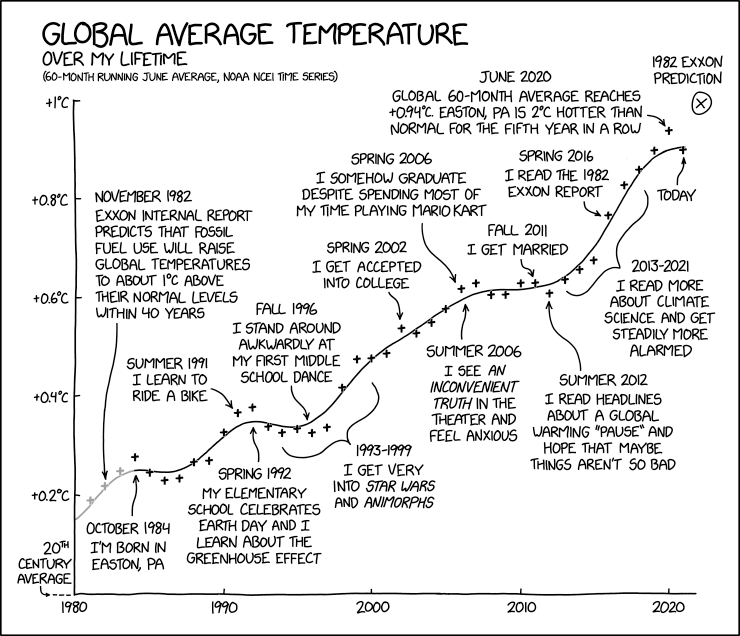
XKCD on climate change. He includes a link to the referenced Exxon internal report that predicts a 1°C increase in average global temperatures by 2022 (check out page 14 of the report). Shades of Big Tobacco…

XKCD on climate change. He includes a link to the referenced Exxon internal report that predicts a 1°C increase in average global temperatures by 2022 (check out page 14 of the report). Shades of Big Tobacco…
• Eric Lander, the President’s Science Adviser, has an excellent opinion piece in the Washington Post describing some of the measures we should take to protect the public’s health going forward: As bad as covid-19 has been, a future pandemic could be even worse — unless we act now
Kim Stanley Robinson does a superb job of rendering climate change’s near future earth in The Ministry for the Future. Warning – the book’s first chapter is one of the most harrowing I have ever read. The author says “the situation we’re in is radically dangerous” and thoroughly convinces you that it is so. Interwoven throughout are some possible social, scientific, and economic interventions that may be of value – or ultimately necessary, solutions that may result in a reduction in global inequality. Ezra Klein’s most important book of 2020, one of Barack Obama’s favorite books of the year. Bill McKibben writes in the NY Review: “Kim Stanley Robinson’s new book is a gift to the world–a novel pitched perfectly to this precise moment in the climate crisis.” and “The New Yorker once asked if Robinson was “our greatest political novelist,” and I think the answer may well be yes.” Hopefully reading this work will inspire many to work for change. Read it.
• Paul Krugman, writing in the NY Times on personal freedom as an excuse for vaccine hesitancy:
“Once you understand that the rhetoric of freedom is actually about privilege, things that look on the surface like gross inconsistency and hypocrisy start to make sense.
Why, for example, are conservatives so insistent on the right of businesses to make their own decisions, free from regulation — but quick to stop them from denying service to customers who refuse to wear masks or show proof of vaccination? Why is the autonomy of local school districts a fundamental principle — unless they want to require masks or teach America’s racial history? It’s all about whose privilege is being protected.“
Yup.
• Another terrific column from Ezra Klein, writing in the NYT: “What if the Unvaccinated Can’t Be Persuaded?” I particularly liked this line:
“Over and over again throughout this pandemic, the same pattern has played out: We haven’t done enough to suppress the virus when we still could, so we have had to impose far more draconian lockdowns and grieve far more death, once we have lost control. For this reason among many, I urge those who object to vaccination passports as an unprecedented stricture on liberty to widen their tragic imagination.“
Highly recommended…
David Leonhardt asks an important question in his July 27’s “The Morning” NYT newsletter. Conservative supreme court justices retire by their 80s. Some liberals don’t. Why not?
• Kristen Panthagani PhD (now completing her MD) has put together a nicely done blog. “You Can Know Things,” that serves as an explainer and fact checker, mostly for things COVID. Check it out here. Well done, Kristen!
Two nice examples:
Pandemic Contradictions and this animated graphic of US Covid related deaths and vaccinations:
this gif pauses at the end, but for some reason viewing in a browser (but not the app) cuts off the pause. so for those who want to savor the full picture at the end (as the gif intends it), here it is: pic.twitter.com/3UeL5Bi3az
— Kristen Panthagani, PhD (@kmpanthagani) June 10, 2021
• Another excellent Morning item from David Leonhardt in the NYT. He discusses virulence (severity) and contagiousness of the delta variant and does a very good job of it. The quick summary: it’s a lot more contagious, but probably not much (or any) more virulent. This comports with the usual evolutionary selection pressures operant in a massive pandemic – the mutant virus that spreads more easily (is more contagious) can reproduce more efficiently by infecting many more hosts. But if it kills too many hosts too quickly (more virulent) it won’t be able to reproduce and spread as efficiently. The biggest issue for delta is that it is so contagious it will likely keep a huge portion of the world’s unvaccinated population infected for many months, and even if not more virulent, big numbers of infection mean more severely ill folks and deaths. And of course a large pool of infected individuals provides ample opportunity for more mutations to arise that might be more contagious still, more virulent, or escape vaccine induced immunity.
I applaud the Society for Healthcare Epidemiology of America (SHEA), the Society for Post-Acute and Long-Term Care Medicine (AMDA), The Association for Professionals in Infection Control and Epidemiology (APIC), the Infectious Diseases Society of America (IDSA), the HIV Medicine Association (HIVMA), the Pediatric Infectious Diseases Society (PIDS), and the Society of Infectious Diseases Pharmacists (SIDP) for producing their consensus statement recommending that:
“COVID-19 vaccination should be a condition of employment for all healthcare personnel. Exemptions from this policy apply to those with medical contraindications to all COVID-19 vaccines available in the United States and other exemptions as specified by federal or state law…
Prior experience and current information suggest that a sufficient vaccination rate is unlikely to be achieved without making COVID-19 vaccination a condition of employment.
The statement is consistent with federal law and regulations.”
The panel conducted an eight-week review of evidence on the three vaccines authorized for use in the United States, vaccination rates, and employment law to develop the statement.
Primum non nocere. I believe that we in health care have a moral obligation to do all we reasonably can to protect our patients and fellow workers.
Kara Swisher has an excellent opinion piece in the NY Times where she discusses DJT’s very lame lawsuit against Twitter, Facebook, and YouTube. An excerpt:
“Since then, Mr. Trump has been casting around for a replacement: first via a lame blog that sputtered out and then by dribbling out rumors that he was building his own social network. As that has turned out to be complicated, his latest scheme — and it is a scheme, all right — is to file a class-action lawsuit with himself as lead plaintiff, alleging that Facebook, Twitter and YouTube have violated his First Amendment rights.
As if.
It’s clear that Mr. Trump’s ability to communicate the way he likes — loud, unfettered — has been hindered by his exile, even if his most pernicious lies about election fraud have managed to crawl, like misinformation slime mold, into a large part of the body politic. And part of me thinks he actually had gotten addicted, like a lot of us, to erupting at any time, day or night, with whatever message popped into his manic mind.”
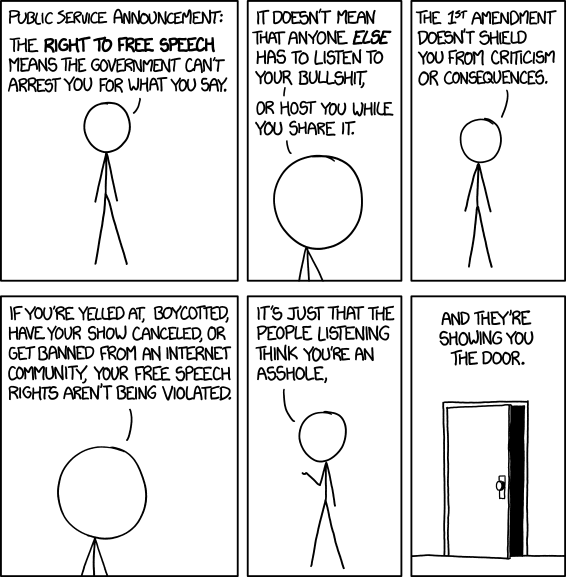
Similar misappropriation of the 1st Amendment is perfectly encapsulated by this comic from Randall Munroe’s excellent XKCD: